

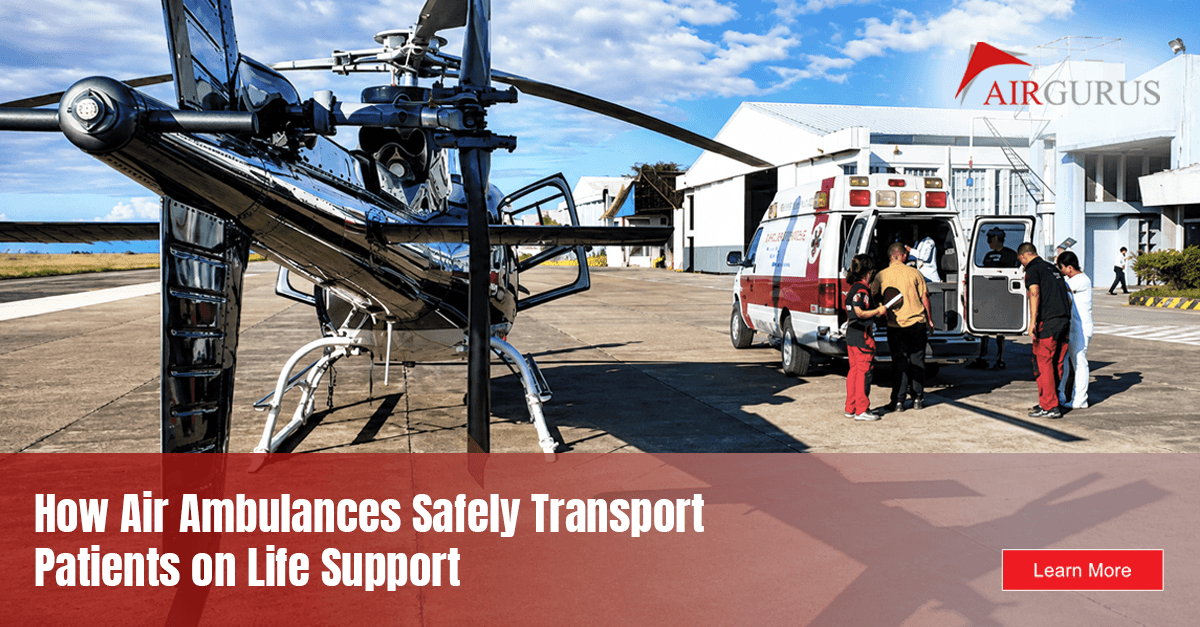
How Air Ambulances Safely Transport Patients on Life Support
Moving a critically ill patient is never as simple as getting from one hospital to another. For patients on life support, air ambulance transport allows the medical team to continue essential care throughout the transfer. A ventilated patient cannot simply be disconnected from their equipment. Medications and monitoring may also need to continue without interruption.
An air ambulance makes it possible to move these patients while keeping essential medical support in place. But how is this done safely in an aircraft? The medical team prepares the patient and secures critical equipment before departure. They also maintain care during the flight and complete the hospital handover after landing.
Before Air Ambulance Transport: Preparing the Patient and Equipment
Safety begins before the aircraft takes off. The medical team reviews the patient’s condition, current treatment, medications, and level of life support to determine what will be required throughout the transfer. The patient is stabilized as much as possible before departure, while essential equipment and medications are prepared and checked.
Patients requiring mechanical ventilation, oxygen therapy, continuous medication, or cardiac monitoring need appropriate equipment and sufficient supplies throughout the flight. The air medical team prepares these resources before departure. Ventilators, monitors, infusion pumps, and other equipment are secured for use during transport.
The referring hospital, air medical team, and receiving facility also coordinate the transfer so the patient’s care can continue smoothly from one facility to the next.
During the Flight: Maintaining Continuous Critical Care
Once airborne, life support continues without interruption. Depending on the patient’s condition, an ICU air ambulance may provide mechanical ventilation, oxygen therapy, cardiac monitoring, and medication infusion throughout the flight.
A transport ventilator can provide controlled respiratory support for patients who cannot breathe adequately on their own. The medical team monitors oxygen levels and respiratory status and adjusts support when necessary.
Continuous monitoring may include ECG, blood pressure, oxygen saturation, respiratory rate, and other vital signs. This allows the medical team to identify changes in the patient’s condition and respond promptly.
Patients who require continuous intravenous medications can also receive them through infusion pumps during the flight. The medical team manages medication doses, fluids, and other treatments according to the patient’s needs.
After the Flight: Safe Transfer to the Receiving Hospital
Medical care does not end when the aircraft lands. The medical team transfers the patient to ground transportation or directly to the receiving facility, depending on the circumstances. They maintain the necessary life support throughout the transfer.
The air medical team provides a clinical handover to the receiving healthcare team, including information about the patient’s condition, medications, treatments provided, and any changes during the journey. Clear communication during patient transfers helps the receiving team continue care safely and without unnecessary delays. WHO Prehospital Emergency Care Toolkit
For patients on life support, the safety of an air medical transfer depends on maintaining appropriate care before departure, throughout the flight, and after landing.
Air Ambulance Transport: Safe Critical Care From Departure to Arrival
Transporting a patient on life support requires more than an aircraft equipped for medical transport. It requires a coordinated team capable of maintaining critical care throughout the journey and responding to the patient’s changing needs.
Airgurus provides air ambulance, air medical, and medevac services for patients requiring medically supervised transport across the Philippines and selected destinations in Asia, including Korea, Japan, and China. With specialized equipment and trained medical teams, Airgurus coordinates each transfer according to the patient’s condition and required level of care.
Whether a patient needs an ICU air ambulance for a critical hospital transfer or medically supervised transport between regions, Airgurus helps ensure that essential care continues from one facility to the next.
When life support must continue, Airgurus brings critical care with the patient.
About Airgurus
Airgurus provides fast and reliable air medical service for emergencies, ensuring safe and efficient patient transport. Our CAAP and DOH compliant air ambulance team offers dependable air ambulance and medevac solutions, including ICU air ambulance care, rescue helicopters, and life flights for urgent situations. We manage both domestic and international medevac, coordinating with hospitals and healthcare professionals to ensure patients reach the right medical facilities across the Philippines and beyond. Whether it’s city-to-city transfers or reaching remote areas, Airgurus prioritizes safety, speed, and patient comfort. Call our air ambulance number +63 9178857911 today to learn more about how our air medical transport services can support your emergency needs.
Tags: air ambulance, air ambulance cebu, air ambulance company philippines, air ambulance dumaguete, air ambulance in china, air ambulance in singapore, air ambulance japan, air ambulance korea, Air Ambulance Manila, air ambulance palawan, Air Ambulance Philippines, ICU air ambulance, international medevac, Medevac Philippines, medical air transport philippines