

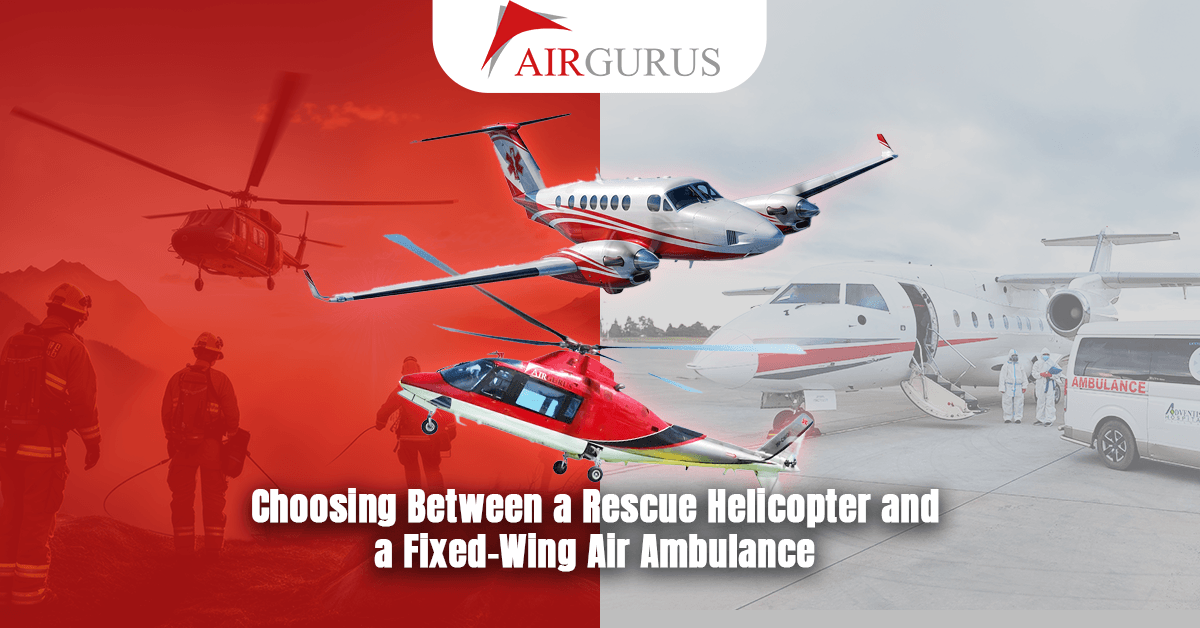
Choosing Between a Rescue Helicopter and a Fixed-Wing Air Ambulance
When a medical emergency requires urgent transport, choosing the right aircraft can be just as important as receiving immediate medical care. While both a rescue helicopter and fixed-wing air ambulance provide medically supervised patient transport, they are designed for different situations. Factors such as the patient’s condition, location, travel distance, and the urgency of the transfer all determine which aircraft is the safest and most effective option.
Understanding the differences between these air ambulance services can help patients, families, and healthcare providers make informed decisions. Choosing the right aircraft also helps ensure safe, timely access to appropriate medical care.
Rescue Helicopter vs. Fixed-Wing Air Ambulance: What’s the Difference?
Although both aircraft safely transport patients under medical supervision, they serve different types of missions.
A rescue helicopter is designed for rapid response over short distances. Since helicopters do not rely on runways, they can operate in locations such as accident scenes, isolated islands, mountainous regions, offshore facilities, and areas affected by disasters. This makes helicopters the preferred choice when immediate evacuation is needed and every minute counts.
A fixed-wing air ambulance, by contrast, supports longer-distance medical transport. These aircraft require airport runways but offer faster travel over extended distances and more cabin space for medical equipment and in-flight care. Medical teams commonly use them for inter-hospital transfers, long-distance critical care, and international medevac missions.
The right choice isn’t about which aircraft is better. The decision ultimately depends on the patient’s condition, the nature of the emergency, and the transport requirements of the mission.
When Is a Rescue Helicopter the Best Option?
A rescue helicopter is ideal for evacuating patients from areas that are difficult to reach by road or fixed-wing aircraft.
These missions commonly include:
Medical emergencies in remote or island communities
Road traffic accidents
Mountain and wilderness rescues
Offshore and maritime emergencies
Disaster response following typhoons, floods, earthquakes, and other natural emergencies
Emergency transfers to nearby hospitals
Because helicopters can land much closer to the patient, they significantly reduce the time needed to begin advanced medical treatment.
When Is a Fixed-Wing Air Ambulance the Better Choice?
A fixed-wing air ambulance works best for longer-distance transfers or when patients need specialized treatment unavailable locally.
Medical teams commonly use these aircraft for:
Hospital-to-hospital transfers across the Philippines
International medevac services
Long-distance critical care transport
Patients requiring an ICU air ambulance
Medical repatriation after illness or injury abroad
With advanced life-support equipment and experienced flight medical teams onboard, fixed-wing air ambulances allow patients to receive continuous medical care while traveling between cities or countries.
How Medical Teams Decide Which Aircraft to Use
The decision to deploy a rescue helicopter or a fixed-wing air ambulance depends on the patient’s condition and the requirements of the mission. The World Health Organization (WHO) highlights the importance of safe and coordinated medical evacuation, including clinical care and operational planning.
Before every mission, medical coordination teams consider:
The patient’s medical condition and stability
The urgency of the transfer
The distance to the receiving hospital
Accessibility of the patient’s location
Availability of airports or suitable landing areas
Weather and flight conditions
The level of medical care required during transport
By evaluating these factors, medical teams can determine the safest and most efficient transport solution for every patient.
Finding the Right Air Medical Transport Solution
There is no single aircraft that is suitable for every medical emergency. Rescue helicopters and fixed-wing air ambulances each play a vital role in emergency healthcare, with one providing rapid access to patients in difficult-to-reach locations and the other delivering safe, long-distance transport for patients who require ongoing medical care during the journey.
At Airgurus, every mission starts with a comprehensive medical and operational assessment to determine the safest transport plan for the patient. Whether a patient requires rapid evacuation by rescue helicopter or long-distance transport by fixed-wing air ambulance, our experienced medical coordination team selects the most appropriate aircraft to ensure safe, efficient, and medically supervised care from departure to arrival. From domestic transfers within the Philippines to complex international medevac operations, we are committed to helping patients reach the right medical facility when every minute matters.
About Airgurus
Airgurus provides fast and reliable air medical service for emergencies, ensuring safe and efficient patient transport. Our CAAP and DOH compliant air ambulance team offers dependable air ambulance and medevac solutions, including ICU air ambulance care, rescue helicopters, and life flights for urgent situations. We manage both domestic and international medevac, coordinating with hospitals and healthcare professionals to ensure patients reach the right medical facilities across the Philippines and beyond. Whether it’s city-to-city transfers or reaching remote areas, Airgurus prioritizes safety, speed, and patient comfort. Call our air ambulance number +63 9178857911 today to learn more about how our air medical transport services can support your emergency needs.
Tags: air ambulance, air ambulance cebu, air ambulance company philippines, air ambulance dumaguete, air ambulance in china, air ambulance in singapore, air ambulance japan, air ambulance korea, Air Ambulance Manila, air ambulance palawan, Air Ambulance Philippines, ICU air ambulance, international medevac, Medevac Philippines, medical air transport philippines