Every second counts. This is why air ambulance services in the Philippines are important in medical emergencies. Emergencies can strike anytime and anywhere to anybody that is why air ambulance services in the Philippines are important.
It all happens to anyone and we never would know when and where it is going to strike but. Due to this, Airgurus’ air ambulance services are always on a stand-by 24/7. We could be on a business trip, during vacation, driving, hiking with friends when an emergency strikes. Also, we could be anywhere far from a city or town in the Philippines where medical facilities are not adequate. Remember that the distance between our physical location and the nearest qualified hospital takes us to the golden hour. These are the hours that can mean life or death.
It is critical that we know our medical evacuation options in the Philippines. There are two types of medical evacuation in the country providing transport for urgent medical care situations:
1. Ground Ambulance (The medically suited-up, upgraded van)
Ground ambulances are most common in the Philippines especially in main town proper and cities. Yet, ground ambulances are often limited in range and availability. These factors make them often not practical for medical evacuation. Patients have the tendency to suffer from complications like seizures or heart attack leading to death while being stuck in traffic.
While it provides us some adequate help in the cities, ground ambulances are of limited help in remote areas.
2. Air Ambulance (The medically suited-up aircraft)
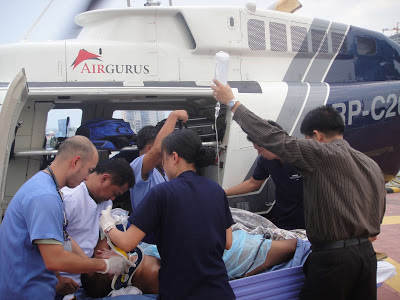
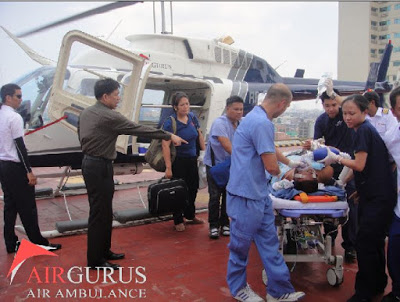
A lot of people are skeptical about using a helicopter or aircraft. The cost of getting an air ambulance is the first thing that comes into their mind. People don’t realize is that its a very effective emergency medical transport. And, that can reach us anywhere swiftly and take us to where we can get the medical care we need.
We often hear about or see air ambulances in televised news coverage. These involves remote vehicular accidents, mountain rescues, diving accidents, etc. We watch it all the time on TV or movies in war rescues and ambush situations. In action, we witness air ambulances transporting trauma patients to rooftops of hospitals. Another is, picking up patients from inaccessible places to waiting ground ambulances near medical facilities. Furthermore, we see repatriation of surviving victims from tragedies to trauma facilities, etc.
Airgurus’ emergency hotlines are on a standby 24/7: +632 6248274 | +632 2749758 | +63 925 8892985 and +63 917 8857911. You may also email at info@airgurus.ph.
What is the most number of air ambulance Philippines case that we encounter most? Airgurus is saving thousands of patients via our air ambulance service in the Philippines.
Most of these cases we encounter entails the patients to be in the golden hours. It is the hours between life and death. What tops our list are patients with diseases of the heart.
Since we have posted the news last February 2012 in our old website, the numbers haven’t gone down and the Department of Health declared that heart disease is the leading cause of death in the Philippines till now.
We at Airgurus, can’t help but be concerned and so we are giving some friendly reminders to our followers on how to take care of your heart:
1. STOP SMOKING
Smoking or using tobacco is found to be one of the most significant risk factors for developing heart diseases. The chemicals in tobacco damages the heart and blood vessels leading to the narrowing of the arteries (atherosclerosis). Atherosclerosis can ultimately lead to a heart attack. When it comes to heart disease prevention, no amount of smoking is safe. Smokeless tobacco, low-tar and low-nicotine cigarettes are also risky, as is exposure to secondhand smoke. Social smokers are not even spared.
A new law has taken effect last month… Philippine Executive Order 26, entitled Providing for the Establishment of Smoke-Free Environments in Public and Enclosed Places. This was issued by Philippine President Rodrigo Duterte. This executive order invoked the Clean Air Act of 1999. The Tobacco Regulation Act of 2003 is to impose a nationwide ban on smoking in all public places in the Philippines. We hope that with this new law, it will significantly decrease the number of patients suffering from heart attacks.
2. EXERCISE FOR 30 MINUTES A DAY
A regular daily exercise can reduce the risk of fatal heart diseases. Combining physical activity with other lifestyle measures is always of great help. Physical activities help control one’s weight. It can reduce chances of developing other conditions that may put a strain in one’s heart, such as high blood pressure, high cholesterol and diabetes. It also reduces stress which may be a factor in heart disease. Swimming is the best and the highly recommended activity on exercises.
3. EATING A HEARTY BUT HEALTHY DIET
Eating food that are low in fat, cholesterol and salt is a good start. Fruits, vegetables, whole grains and low-fat dairy products can help protect your heart. Beans, other low-fat sources of protein and certain type of fish also can help reduce risks of heart diseases. Limiting certain fats consumption also is important. Heart-healthy eating isn’t all about cutting back. Most people need to add more fruit and vegetables to their diet with a goal of 5 to 10 servings a day. So eat a lot of fruits and vegetables. On decreasing risks of heart attack, some fish like salmon and mackerel are good natural sources of Omega-3 fatty acid (a type of polyunsaturated fat).
When other means of transportation could endanger a patients health like if you have a health condition that requires this type of transportation, call Airgurus. Our 24/7 staff will be be able to assist you to deploy air ambulance services to nearest appropriate medical facility where you can be given the utmost care care you need.
For more info, please call +63 917 8857911. You may also email at info@airgurus.ph.
How do you create an emergency preparedness and response in a workplace? Half the time, the difference between living and dying lies on just how fast the response to the emergency happens. It’s the ugly truth. When people realize that they could’ve saved a life had they known what to do or acted upon it immediately, the thought is almost depressing. However, no one could be and should be blamed for it.
Emergencies happen in the least expected time. That’s why, there is a need to create emergency preparedness plan for whatever the situation is, just like in any workplace.
Each organization must have a plan for when emergencies do happen.
Here are some guidelines for creating an emergency preparedness and response plan in the workplace.
List down possible workplace hazards.
Have a professional hazards inspector check the building. This is to make sure that every nook and cranny have been carefully observed. It may be a daunting task but it is a must to come up with a thorough analysis and be able to provide of what may possibly cause an emergency.
Consider the wirings.
Wiring is a huge component of most companies these days. Make sure that your wiring system is still very much intact and that some of the wires haven’t been preyed upon by rats. Also, some wiring materials are made of plastic that is considered a fire hazard.
Check hallways, stairs, and other rooms
Do a thorough checking of the common areas of the building that hasn’t been given proper attention. This includes hallways, stairs, and supply rooms. See if the hallways and stairs are well-lighted, or if the supplies room is arranged. This is to make sure that none of the potentially harmful chemicals there will cause danger to anyone.
Prepare a backup power source.
In case of blackouts, there should be an alternate power source so that operations could still push through, at least until the electricity comes back.
Devise an evacuation plan.
A general rule for evacuating: there should be at least two escape routes for every room in the building. That may seem too much for some. But this is a guideline for evacuation in case of emergencies. Also, make sure that the organization practices evacuation drills so that the people know what to do in the event of the exact emergency.
It should also be noted that an organization should have emergency contact numbers of hospitals and ambulance. Keep Airgurus at the top of your emergency list. Visit our website to know more about our services.
We all know that air ambulance is not as common as the ordinary ambulance we hear on the road. Emergency response entails a cost, be it on the ground or in the air. But the thing with air ambulance is that the price is a mile away compared to the regular ambulance, and usually not covered by health insurances.
Calling an ambulance is clearly justified if you or someone you’re with is undergoing an emergency situation. Some of these are when you or someone is unconscious, bleeding heavily, can’t breathe, or can’t be transported safely any other way.
Calling an ambulance is no joke, how much more when calling an air ambulance. To help you make the right decisions in times of uncertainty, here are the things you need to weigh before calling for one.
Assess the danger in the situation
* Emergencies to some extent are not equally life-threatening in a matter of minutes. There are instances when an emergency does not require medics on the spot. If you don’t think your situation is a real emergency, and the person you’re with can still ride a taxi or a car, don’t call an ambulance.
Assess the distance of the nearest hospital
* Sometimes, in case of emergencies, we panic to a point that we forget to check the distance of the nearest hospital. Remote areas with poor road condition are perfect examples to call an air ambulance. Cases like accidents during hiking or mountain climbing also require the service of an air ambulance.
***
The thing is, the air ambulance is really a lifesaver. These can be the bridge between a hairline distance of life and death in times of emergencies.
For more information about Airgurus air ambulances or medical air transport, you can visit airgurus.ph. or call them at 0917-885-7911
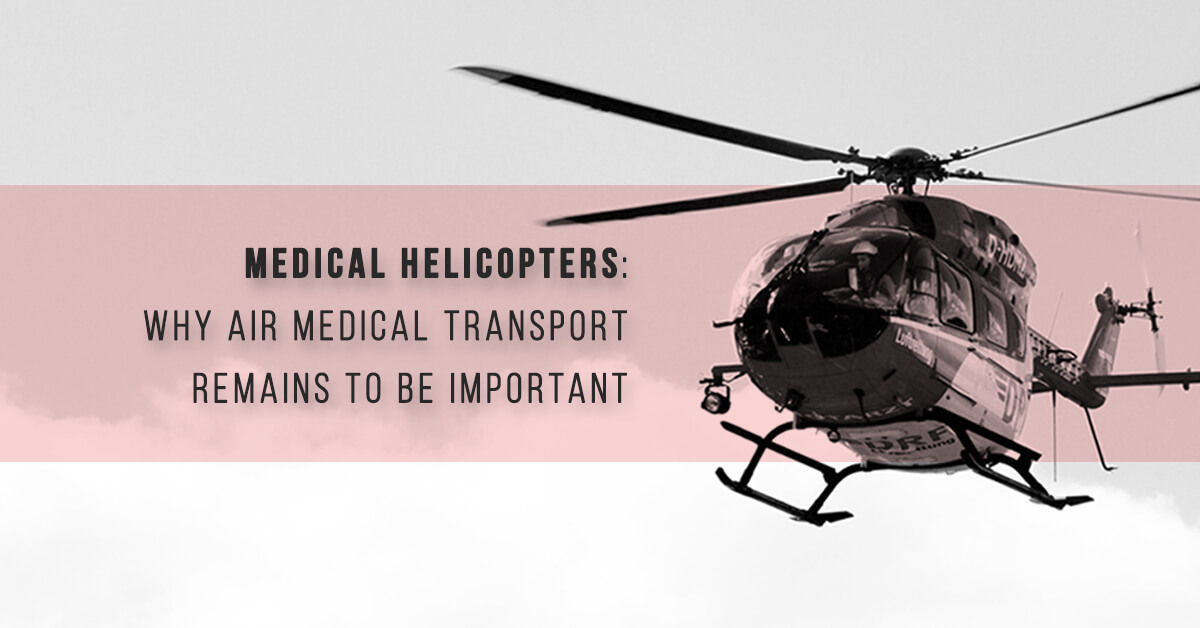
On a completely normal day, medical helicopters and other forms of air medical transport will not cross the mind of any living soul. If you don’t need something, you barely think of it at all. But at the face of an emergency, the need for medical helicopters undoubtedly rise out of the blue.
Over the years, medical helicopters have not been given the recognition they deserved. Air medical transport systems aren’t as much sought after as ambulances, and so, they aren’t as commercially known and endorsed by the general public as compared to ambulances. When emergencies emerge, people only call out to what they have come to know and that has always been the trustee big white van.
What most people fail to see is how important the air medical transport system is. One may think, alright, how much do we really need this medical helicopter? Why go for it when it’s way more expensive? If you think medical helicopters are expensive, well, how much is your life?
Granted, the need for medical helicopters arise from extreme and remote cases. These situations can range from getting help from an isolated location to a patient clinging on for dear life with only minutes to spare. And right then and there, you can sense the gravity of the need for an efficient air medical transport system.
Think about this. A medical helicopter can make the difference between life and death. That alone is reason enough to stand by the importance of emergency medical helicopters.
Professionals are keen on improving the services offered by air medical transport providers. A little faith goes a really long way.
Airgurus is an emergency helicopter/air medical transport provider. In case of emergency, don’t hesitate to contact us.